Blog

Tooth Extraction
Blog

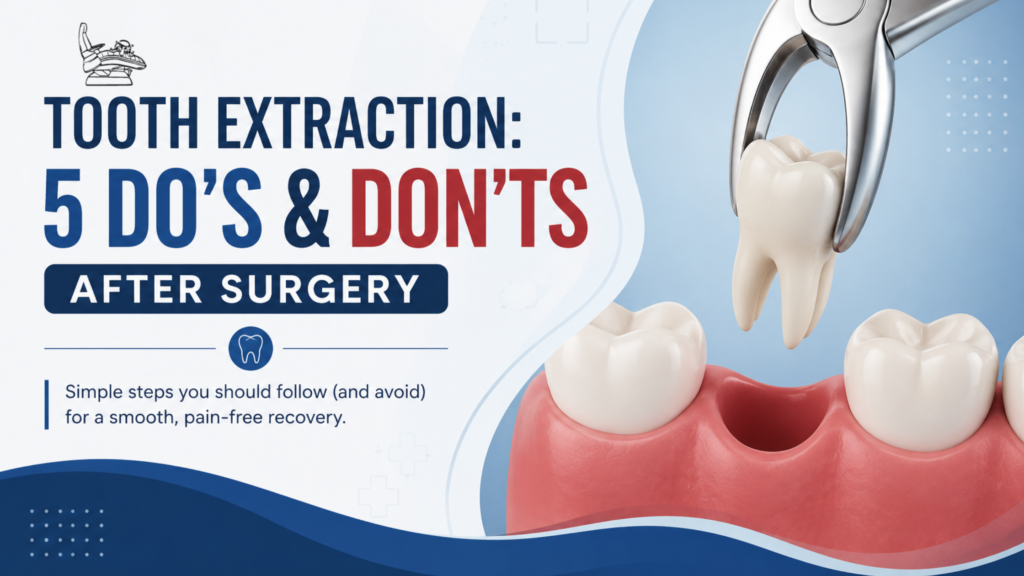
Tooth Extraction: 5 Do’s and Don’ts After Surgery

After a Tooth Extraction, most people fixate on the pain. Fair enough. But what actually derails healing — what sends people back to the dentist with dry socket, infections, or prolonged bleeding — is almost always a mistake made in the first 24 to 48 hours after the procedure. Here’s what you need to do (and stop doing) to heal properly. The Do’s 1. DO Use Salt Water — But Not Right Away salt water gargling after tooth extraction is one of the most commonly searched questions after a procedure, and the answer trips people up. Salt water rinses work. Warm salt water (half a teaspoon in a glass of water) keeps bacteria down and supports soft tissue healing. But timing matters: don’t start rinsing until 24 hours after surgery. Rinsing too early dislodges the blood clot that’s forming in the socket — the very thing your body is trying to build to protect exposed bone and nerve endings. After that first day, rinse gently 2–3 times daily, especially after meals. No vigorous swishing. No gargling. Just let it roll around and spit slowly. 2. DO Follow Your Dentist’s Aftercare Instructions to the Letter This sounds obvious. It isn’t. People skip doses, eat things they’re told not to, and stop taking antibiotics early because they feel fine. At Pembroke Family Dental, post-operative care instructions are tailored to each patient — because a straightforward extraction of a front tooth heals differently than an impacted wisdom tooth removal. What your neighbor was told after their procedure may not apply to you. If you weren’t given written instructions, ask for them before you leave the chair. If something isn’t clear, call the office. Don’t guess. 3. DO Eat Soft, Cold Foods in the First 48 Hours Can I eat ice cream after tooth extraction? — yes, actually, and it’s one of the better choices you can make. Cold foods reduce swelling. Soft foods don’t disturb the clot. Ice cream (plain, no crunchy mix-ins), yogurt, mashed potatoes, smoothies, and scrambled eggs are all fine. What you’re avoiding is heat, hard textures, and anything that requires serious chewing near the extraction site. One thing most people don’t think about: eat on the opposite side of your mouth. Keep food and utensils away from the socket entirely for the first few days. 4. DO Rest and Keep Your Head Elevated Your body heals faster when it’s not working against gravity. For the first night, sleep with your head propped up on an extra pillow. This reduces blood pooling at the surgical site, which cuts down on swelling and throbbing pain. Rest also means actually resting — not going back to work the same afternoon if you don’t have to. Physical activity raises your heart rate and blood pressure, which increases bleeding risk. Take the day seriously. 5. DO Monitor for Warning Signs Normal healing includes: mild bleeding (pinkish saliva) for up to 24 hours, swelling that peaks around day 2–3, and soreness that gradually decreases. What’s not normal: sudden severe pain 3–5 days after extraction (this is classic dry socket), fever, pus, or swelling that gets worse instead of better after day 3. If you’re a patient at Family Dental in Virginia Beach, don’t wait it out — call the office. Dry socket and post-extraction infection are both treatable, but they get worse if ignored. The Don’ts 1. DON’T Use Mouthwash in the First 24 Hours Can you use mouthwash after tooth extraction? Most commercial mouthwashes — including alcohol-based ones — are too harsh in the immediate post-op period. Mouthwash after tooth extraction risks: the swishing action can dislodge your blood clot, and alcohol-based formulas can irritate the wound. What to avoid after tooth extraction includes products like Listerine, peroxide rinses, and anything with strong antibacterial chemicals in the first day. After 24 hours, if your dentist specifically cleared it, a mild, alcohol-free mouthwash may be fine — but salt water does the job better and with less risk. 2. DON’T Smoke or Use Straws Both involve negative pressure (sucking). That pressure can pull the blood clot right out of the socket, causing dry socket — an exposed, deeply painful nerve that can sideline you for days. Smoking doubles the problem: nicotine restricts blood flow to healing tissue, and the chemicals in cigarette smoke interfere with the immune response. If you smoke, your healing timeline is already slower than average. Lighting up in the first 72 hours makes it significantly worse. Straws are the same mechanical risk as smoking. Use a cup, drink slowly, and keep liquids lukewarm to cool — not hot. 3. DON’T Poke, Probe, or Touch the Socket The urge to check on it with your tongue is almost universal. Resist it. Touching the clot — with your tongue, a finger, or a toothpick — can dislodge it or introduce bacteria. Brush your other teeth normally, but keep the toothbrush away from the extraction site for the first 24 hours. After that, brush gently around it, not on it. 4. DON’T Take Aspirin for Pain Aspirin thins blood. After a tooth extraction, you need clotting. Taking aspirin for pain relief is actively counterproductive. Ibuprofen (like Advil) or acetaminophen (like Tylenol) are better choices, and your dentist may have prescribed something stronger. Take whatever was recommended on schedule — not just when the pain gets bad — because staying ahead of inflammation is easier than trying to knock it back down. 5. DON’T Ignore Dry Socket About 2–5% of extractions lead to dry socket. The risk goes up significantly after lower molar extractions, in smokers, and in patients who didn’t follow post-op care instructions. The symptom is hard to miss: intense, throbbing pain that radiates toward your ear, usually appearing 3–5 days after extraction — right when you thought you were through the worst of it. The socket looks empty or grayish instead of dark red. It’s not an emergency, but it does need treatment. Your dentist will clean the socket and place

preventive dental care
Blog

The Importance of Preventive Dental Care: Building Healthy Habits for Life

Introduction Most people visit the dentist reactively. Something hurts, or a friend says something looks off, and suddenly an appointment gets booked. In between those moments? Nothing. This isn’t unique behavior. Dental problems are quiet. A cavity forming in a back molar won’t announce itself for months — sometimes years. By the time you feel it, you’re no longer looking at a cleaning. You’re looking at a filling, possibly a root canal, and the kind of bill that makes you wish you’d gone six months earlier. Preventive dental care exists for exactly this reason. Not to scare you into the chair, but to keep small problems from turning into expensive ones. What Is Preventive Dental Care? What is preventive dental care, stripped of jargon? It’s every action — at home and at the dentist — taken to stop oral health problems before they develop. That includes brushing and flossing daily, eating in a way that doesn’t feed bacteria, getting professional cleanings on schedule, and letting your dentist catch issues while they’re still manageable. What is preventive dentistry as a field? It’s the branch of dentistry that focuses on maintaining oral health rather than repairing it. Restorative work — fillings, crowns, implants — becomes necessary when prevention breaks down. But restorations are always a fallback. They’re never the goal. The goal is a mouth that doesn’t need that work. What Are Dental Preventive Services? When people ask what are dental preventive services, they expect a short answer. It’s actually a broader category than most realize. Professional services: Routine cleanings (prophylaxis) — Removes hardened plaque (tartar) that brushing can’t reach. Most patients need this every 6 months; those with gum disease history may need it more often. Oral exams — Your dentist checks for cavities, gum disease, bite problems, signs of wear, and early indicators of oral cancer. Dental X-rays — Catches decay between teeth, bone loss, and impacted teeth before they’re visible or symptomatic. Fluoride treatments — Strengthens enamel. Useful for children, and for adults with higher cavity risk than average. Dental sealants — A thin coating applied to the chewing surfaces of back teeth. Shown to dramatically reduce cavity rates in children and teenagers. Periodontal screenings — Gum disease is the leading cause of adult tooth loss. Catching it early changes the treatment outcome significantly. Oral cancer screenings — A quick check your dentist can do during any routine visit. Early detection matters a lot here. At-home practices: Brushing twice daily with fluoride toothpaste Flossing once daily Replacing your toothbrush every 3–4 months Limiting sugary and acidic foods and drinks Using mouthwash when your dentist recommends it These two sides — professional and at-home — make up a full preventive treatment dental program. They depend on each other. Skipping either one leaves real gaps. The Real Cost of Skipping Routine Dental Visits The routine dental visits importance isn’t just about your health. It’s about your wallet. Here’s what the math looks like: A small cavity caught at a routine visit: roughly $150–$300 to fill That same cavity, left undetected until it reaches the pulp: a root canal ($700–$1,500) plus a crown ($1,000–$1,800) Untreated gum disease progressing to bone loss: periodontal surgery or implants, which run into thousands Most dental insurance covers preventive visits at 100%. Restorative work typically comes in at 50–80% coverage. The gap between those two numbers is exactly what neglect costs. There’s also the health piece, which gets underplayed. Chronic gum disease is linked to higher risk of cardiovascular disease, diabetes complications, preterm birth, and respiratory infections. Bacteria living in infected gum tissue don’t stay contained in your mouth. They enter the bloodstream. Two cleanings a year isn’t just about keeping your teeth — it’s managing systemic inflammation that starts in your gums. Preventive Dental Care Tips You Can Start Today Most of preventive dental care happens at home, not at the dentist. Brush correctly, not just often. Two minutes, twice a day, with a soft-bristled brush. Angle the bristles toward the gumline at 45 degrees. Most people brush the flat surfaces and miss the gumline almost entirely — which is exactly where decay and gum problems start. Floss. Actually floss. Brushing covers about 60% of tooth surfaces. Flossing covers what’s left. Skipping it means leaving roughly half your mouth unclean every night. Watch what you drink. Soda, sports drinks, and fruit juice are acidic. They soften enamel every time they contact your teeth. If you drink them regularly, use a straw and rinse with water afterward. It’s not a perfect fix, but it helps. Take dry mouth seriously. Saliva neutralizes acids and washes bacteria off teeth. Medications, mouth breathing, and simple dehydration all reduce saliva flow. If your mouth is frequently dry, mention it to your dentist — it raises cavity risk considerably. Replace your toothbrush before it looks worn. Frayed bristles don’t clean well. Most people wait too long. Set a calendar reminder every three months and don’t overthink it. Keep your dental appointments even when nothing hurts. This sounds obvious. It isn’t — because the whole point of preventive care is that nothing hurts yet. Skipping a cleaning because you feel fine is backwards thinking. What Preventive Dentistry Looks Like for Families Children’s teeth are not just smaller adult teeth. They have thinner enamel, they decay faster, and the habits formed around them tend to stick for life. For kids, preventive dentistry means: First dental visit by age 1, or within 6 months of the first tooth erupting Sealants applied to permanent molars as soon as they come in Fluoride varnish every 6 months Learning correct brushing technique early — with a parent supervising until around age 8 For adults, the focus shifts. Gum disease risk climbs. Recession becomes something to watch. Teeth grinding — often stress-driven — quietly wears enamel down for years before anyone notices. A night guard is a cheap solution to an expensive problem. Most people never get one because they don’t know they grind their teeth. There’s a

teeth whitening
Blog

Is Whitening Toothpaste Bad for Your Teeth? A Dentist’s Honest Answer

Every week, someone sits in our chair and asks some version of this question. Usually after their teeth started feeling sensitive. Sometimes after a friend told them whitening toothpaste “destroys your enamel.” Occasionally after reading something alarming online. So here’s what we actually tell patients: it depends on how you’re using it. That answer frustrates people, but it’s the right one — because whitening toothpaste isn’t one thing. The tube in your bathroom might work very differently from the one your coworker uses. And the risks aren’t random; they follow pretty predictable patterns once you understand what’s inside. How Whitening Toothpaste Actually Works Most people assume it bleaches. Sometimes it does. But there are really two different things happening depending on the product, and mixing them up is part of why people get confused about safety. Abrasives are in nearly every whitening toothpaste — hydrated silica, calcium carbonate, sodium bicarbonate. These physically scrub surface stains off your enamel. Coffee, tea, red wine, tobacco — those stains sit on the outer surface, and abrasives remove them the same way a rough sponge removes grime. The underlying color of your tooth doesn’t change. The tooth just gets cleaner. Chemical bleaching agents — hydrogen peroxide and carbamide peroxide — work differently. They penetrate the enamel and break down the compounds that cause deeper discoloration. The concentration in toothpaste is much lower than in professional whitening gels or strips, but with consistent use over weeks, you can get a real shift in tooth color. Not dramatic, but noticeable. Some toothpastes also use a dye called blue covarine. This one’s pure optics — it coats the tooth surface and creates a contrast effect that makes teeth look whiter immediately. No bleaching. No abrasion. Just color science. Why does this matter? Because the risks are different for each type, and knowing which you have changes what you should watch out for. The Real Risks — And When They Actually Happen Whitening toothpaste gets more blame than it deserves in some areas, and not enough in others. Here’s what’s actually worth paying attention to. Enamel erosion is the fear most people have. It’s real, but it’s almost always tied to overuse over a long period — we’re talking years of twice-or-more daily brushing with a high-abrasion formula and too much pressure. The number you want to know is the RDA score (Relative Dentin Abrasivity). The American Dental Association sets 249 as the safety ceiling. Most standard whitening toothpastes sit between 100 and 200. A few aggressive formulas push higher than that. You can look up your specific brand’s RDA — it takes two minutes and tells you a lot. Tooth sensitivity is more common and more immediate. Hydrogen peroxide can irritate the dentin beneath your enamel, especially if you have any gum recession or naturally thinner enamel. That sharp, flinching feeling when something cold hits your teeth — that’s usually what’s happening. It tends to go away when you stop using the product, but it’s a clear signal worth taking seriously. Gum irritation is almost always a technique problem, not a toothpaste problem. Brushing hard with an abrasive paste causes it. Use a soft brush with light pressure and this mostly disappears as a concern. Here’s one nobody tells you: whitening agents don’t touch dental restorations. Crowns, veneers, composite bonding, fillings — none of them respond to peroxide or abrasion. If you have significant dental work, whitening toothpaste may gradually lighten your natural teeth while your restorations stay put. You could end up with a color mismatch you didn’t plan for. Worth thinking about before you commit to daily whitening paste. Is Crest Whitening Toothpaste Actually Safe? Since Crest is what most people are actually using, it’s worth being direct about it rather than speaking in generalities. The Crest 3D White line uses silica as its abrasive and a low concentration of hydrogen peroxide. It carries the ADA Seal of Acceptance — which means the ADA reviewed its safety data and found it acceptable when used as directed. That’s not a blanket endorsement of the product’s whitening claims, just confirmation that it won’t harm you if you use it normally. For a healthy adult without pre-existing sensitivity or recession, using Crest 3D White twice a day with a soft-bristled brush is fine. The problem we see isn’t the product — it’s people who notice sensitivity, feel like it means the whitening is “working,” and push through. It doesn’t mean that. Sensitivity is your teeth asking you to back off. Who Should Not Use Whitening Toothpaste Daily This group is smaller than you’d think from reading the internet, but it’s real: People with documented enamel erosion already underway Anyone with significant gum recession exposing root surfaces (roots have no enamel — there’s nothing to protect them from abrasion) Teeth that already react strongly to hot or cold Anyone with crowns, veneers, or bonding who doesn’t want color inconsistencies developing over time Kids under 12 — maturing enamel doesn’t need abrasive whitening formulas None of this means whitening is permanently off the table. It means get a dentist’s read on your situation before using it daily. Whitening Toothpaste vs. Professional Teeth Whitening in Virginia Beach  This is where we’ll be blunt, because most comparisons aren’t. Whitening Toothpaste Professional Whitening Mechanism Surface stain removal + mild bleaching Deep bleaching of intrinsic stains Results Gradual, subtle over weeks Noticeable in 1–2 sessions Supervision None Dentist-managed Longevity Only works while you keep using it Months to years with basic maintenance Best use Maintaining an already-white smile Actually changing your tooth color Whitening toothpaste is maintenance, not transformation. If your teeth are already at a shade you like and you just want to keep coffee from staining them, it does that job well. If your teeth are genuinely yellow or grey and you want them to look several shades lighter, no amount of daily Crest will get you there. That’s just not what the product does. Professional teeth whitening in Virginia Beach 

dental implants cost
Blog

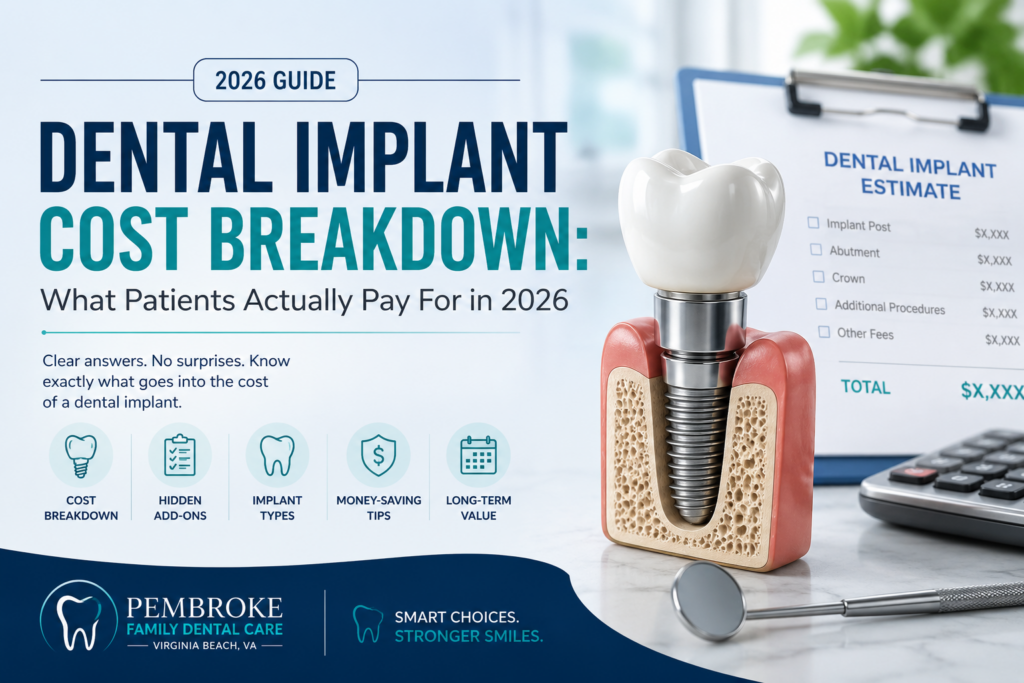
Dental Implant Cost Breakdown: What Patients Actually Pay For in 2026

Most people searching for dental implants price get a number — somewhere between $1,500 and $6,000 — with no explanation of what that number includes. Then they sit down with a treatment coordinator and discover the real total is twice that. This article breaks down exactly where that money goes, what you can skip, what you can’t, and what patients at Pembroke Family Dental Care in Virginia Beach actually encounter during the process. What a Dental Implant Actually Costs in 2026 A single-tooth implant, fully completed with post, abutment, and crown, typically runs between $3,000 and $5,500 in the United States in 2026. That’s the all-in number when no preparatory work is needed. If you need a bone graft, extraction, or CT scan, add another $500 to $5,000 depending on complexity. Full-mouth dental implant surgery — meaning implants across both jaws — ranges from $30,000 to $90,000. That’s not a typo. The variation comes from how many implants are placed, which prosthetic solution you choose, and how much bone work your jaw requires beforehand. Here’s the number most ads won’t show you: the average American patient who goes through a complete single-implant dental implant procedure pays roughly $4,200 to $4,800 out of pocket, after factoring in limited insurance coverage. The Three Core Components You’re Paying For Every dental implant procedure has three distinct parts. Each is billed separately. Each comes with its own price range. 1. The Implant Post This is the titanium screw that gets placed into your jawbone. It acts as an artificial root. Most posts run between $1,000 and $3,000 depending on brand, material (titanium vs. zirconia), and whether a specialist or general dentist performs the placement. The post itself is permanent — barring implant failure, you should never need to replace it. 2. The Abutment The abutment is the connector piece between the post and the visible tooth. Stock abutments are cheaper ($300–$500). Custom-milled abutments designed for your specific bite angle cost more ($700–$1,200). If your implant is in a visible spot — a front tooth, for example — your dentist will likely recommend a custom abutment for a better cosmetic fit. 3. The Crown The crown is the tooth you actually see. Porcelain-fused-to-metal crowns sit at the lower end of the price range ($800–$1,200). Full zirconia crowns — more durable and more aesthetic — run $1,500–$3,000. Crowns are not permanent in the same way the post is. Most last 10–15 years before they need replacement. The post stays; the crown eventually goes. The Hidden Add-Ons That Inflate Your Final Bill This is where patients get surprised. The quoted dental implants cost at a consultation often covers only the three core components above. What it frequently excludes: Consultation fee: $75–$300 Panoramic X-ray: $100–$200 Cone-beam CT scan (CBCT): $250–$600 — required in most cases to assess bone density and map nerve locations before surgery Tooth extraction: $150–$500 for a simple pull; $400–$800 for a surgical extraction Bone graft: $500–$3,000. Necessary if you’ve had bone loss from a long-missing tooth, infection, or periodontal disease. Bone grafts also add 3–6 months of healing time before the implant can be placed. Sinus lift: $1,500–$5,000. Required when upper back molars need implants but the sinus cavity sits too low. This is a surgical procedure with its own recovery period. Temporary restoration: $300–$800. Some patients need a temporary crown or flipper tooth while osseointegration (the process of bone fusing to the implant) takes place over 3–6 months. Sedation: $300–$1,000 depending on whether you choose local anesthesia, nitrous oxide, oral sedation, or IV sedation. A patient who needs an extraction, bone graft, CT scan, and sedation on top of the standard implant components can easily hit $7,000–$9,000 for a single tooth. Not common, but not rare either. Types of Dental Implants and How Each Affects Price Understanding the types of dental implants helps you ask better questions when comparing quotes. Endosteal implants are the standard: titanium screws placed directly into the jawbone. The vast majority of patients get these. Price range as discussed above. Subperiosteal implants sit on top of the jawbone beneath the gum, held by a metal framework. These are rare now — used when bone volume is severely inadequate and grafting isn’t viable. They tend to cost more due to the custom fabrication involved. Mini dental implants are narrower than standard implants. They’re placed in a less invasive procedure, often in a single visit, and cost roughly $500–$1,500 per implant. They’re useful for stabilizing lower dentures or in patients with limited bone. They’re not a direct substitute for standard implants in every situation — don’t let low price alone drive the decision. All-on-4 / All-on-6 implants use 4 or 6 implants per arch to anchor a full-arch prosthesis. Per-arch cost runs $15,000–$30,000. Per implant this looks inexpensive, but the prosthetic fabrication and surgical complexity are substantial. These are permanent, fixed teeth — not removable dentures. Zirconia implants are metal-free alternatives for patients with titanium sensitivities or aesthetic preferences. They cost 20–40% more than titanium equivalents and have a somewhat shorter clinical track record, though outcomes have been improving consistently. Dental Implants vs. Dentures: The Real Cost Comparison Dental implants vs. dentures is the most common comparison patients make, and it’s usually framed the wrong way. Traditional full dentures cost $1,000–$3,500 for a complete set. That’s the upfront number. What the comparison often ignores: Dentures need relining every 1–3 years as the jaw shrinks (yes, your jaw shrinks without tooth roots stimulating bone — that’s not scare tactic language, it’s biology). Relines cost $300–$600 each. Dentures typically need full replacement every 5–8 years: another $1,000–$3,500 each time. Adhesives, cleaning solutions, and repair costs add up over decades. Bone loss from missing teeth accelerates without implants, which can eventually affect facial structure and make future implant placement harder or impossible. Over 20 years, a patient who starts with full dentures often spends $8,000–$15,000 in cumulative maintenance and replacement — without ever getting the stability or bone preservation that implants provide. That

professional teeth whitening
Blog

Professional Teeth Whitening Is the Easiest and Quickest Way to Look Younger

You can spend hundreds on serums, creams, and skincare routines. Or you can sit in a dental chair for an hour and walk out looking noticeably younger. That’s the thing about your teeth — they’re one of the first things people notice, and one of the fastest things to age your face when they’re dull or yellow. Professional teeth whitening is not a gimmick. It’s one of the most reliable, fastest-acting cosmetic procedures in dentistry, with results that show up the same day. If you’ve been browsing teeth whitening kits online or wondering whether natural teeth whitening home remedies are worth your time, this article gives you a clear picture of what actually works — and what’s just marketing. Why Yellow Teeth Make You Look Older Tooth discoloration is not just cosmetic bad luck. It’s biology. As you age, the outer layer of your teeth — enamel — gradually thins. Underneath enamel is a substance called dentin, which is naturally yellow. The thinner the enamel, the more that yellow shows through. On top of that, older enamel becomes more porous, meaning pigments from coffee, red wine, tea, and tobacco grab onto the surface more easily. The result? Teeth that were once white slowly drift toward yellow, gray, or brown — and that drift reads as age on your face. Studies in facial perception research consistently show that tooth color influences how old a person appears. Brighter teeth correlate with looking younger, healthier, and more confident. Fixing this doesn’t require surgery, needles, or weeks of recovery. That’s what makes professional teeth whitening unusually good value for the outcome it delivers. Professional Whitening vs. Everything Else Teeth Whitening Kits and Store-Bought Products Walk down any pharmacy aisle and you’ll find whitening strips, gels, and trays marketed with bold before-and-after claims. They can work — mildly. The active ingredient in most over-the-counter products is hydrogen peroxide or carbamide peroxide, but at a much lower concentration than what a dentist can use. Why lower? Because without professional supervision and gum protection, higher concentrations cause irritation. So you’re left with products that take two to four weeks of twice-daily application to deliver one to two shades of improvement. That’s a lot of effort for modest results. The best at home teeth whitening kits — such as custom whitening trays made by your dentist for home use — sit in a category of their own. These are fabricated from a mold of your actual teeth, use professional-grade gel, and deliver noticeably better results than generic strips. But they still take time, and they require discipline. Natural Teeth Whitening — What It Can and Can’t Do You’ll find plenty of content online about [baking soda teeth whitening], oil pulling, activated charcoal, and turmeric. Some of these have a degree of surface-level abrasive effect — baking soda, for instance, does help scrub off surface stains. But none of them bleach the tooth itself. They clean; they don’t whiten. If your discoloration is intrinsic (inside the tooth, not just on the surface), no home remedy will touch it. Only a peroxide-based bleaching agent penetrates the enamel and breaks down the stain molecules underneath. Use baking soda as an occasional supplement, not a strategy. Best Teeth Whitening Toothpaste Whitening toothpastes work the same way as baking soda — surface abrasion plus, in some cases, a very low concentration of peroxide. They’re good for maintenance after whitening treatment. They will not reverse significant discoloration on their own. The same goes for whitening mouthwash. At the concentration available in over-the-counter rinses, peroxide contact time is far too short to bleach anything meaningfully. These products maintain; they don’t transform. In-Office Professional Whitening: What Actually Happens Dentist teeth whitening — specifically cosmetic teeth whitening done in-office — produces results you can see the same day. Here’s how it works. Before treatment: Your dentist assesses the current shade of your teeth and discusses your target shade. Not everyone starts from the same baseline, and not every tooth whitens at the same rate. Preparation: A protective barrier is applied to your gums. This is what makes professional treatment different from home products — without this step, high-concentration bleach causes chemical burns to soft tissue. Application: A high-concentration bleaching gel (typically hydrogen peroxide at 25–40%) is applied directly to the tooth surfaces. Activation: Depending on the system used, a special light or laser activates the gel and accelerates the whitening process. This is where zoom teeth whitening and laser teeth whitening come in. Result: One session, typically 45–90 minutes, can whiten teeth by six to eight shades. For context, the best at-home kits might achieve two to three shades after weeks of use. Zoom vs. Laser Teeth Whitening: What’s the Difference? Both are in-office professional systems. The distinction matters if you’re comparing options. Zoom teeth whitening uses a blue LED light to activate the whitening gel. The light itself doesn’t bleach — it accelerates the chemical reaction in the gel. Zoom is one of the most widely used professional systems and is well-documented for consistent results. Most patients see six to eight shades of improvement in a single session. Laser teeth whitening uses a laser instead of an LED lamp. The laser delivers more concentrated energy, which can speed up the process further. It’s often slightly more expensive and not every dental practice offers it. For most patients, the outcome difference between Zoom and laser is marginal; both deliver excellent results compared to anything you can do at home. Both options fall under the broader category of cosmetic teeth whitening and should only be done by a licensed dentist. Teeth Whitening Before and After: Realistic Expectations Teeth whitening before and after photos online can be dramatic — and sometimes misleading. Here’s what you should actually expect: Most patients with yellow or light brown staining see six to eight shades of improvement with in-office treatment Grayish discoloration (often from tetracycline antibiotics or fluorosis) responds less predictably — you may need more sessions or a different approach like veneers Whitening does not change the color of crowns,

A clear picture of a bridge for a tooth which shows how it bridges dental gaps, creating a the appearance of a natural, functional smile
Blog

How Does a Dental Bridge Work?

Dental bridges are an everyday restorative procedure to replace missing teeth. It is comprised of artificial teeth (pontics) that are fixed by dental crowns fixed to the natural teeth adjacent or implants. Bridges are used to improve the appearance and function of your smile. They also prevent problems like shifting teeth, bite alignment issues, and problems chewing. What Is a Dental Bridge? Dental bridges are dental restorations made to fill in the gaps left by missing teeth. It is anchored by implant-supported teeth or natural ones. Bridges are constructed from a variety of materials like ceramic, porcelain, metal, or a mixture of them in order to match the natural hue and the strength that your tooth has. What Does a Dental Bridge Look Like? A dental bridge is similar to natural teeth and is designed to seamlessly blend in with the existing teeth. It is typically composed of: Pontic The false tooth replaces the tooth that is missing. Abutments: Crowns that are placed on natural teeth adjacent to them or implants for anchoring the bridge. Framework structure that supports the bridge. It can be ceramic or metal. Bridges are designed to look and function like real teeth, providing a natural appearance and restoring your smile. What Dentist Does Crowns? Prosthodontists and general dentists are dentists who specialize in providing dental crowns. A prosthodontist is a dental specialist with extensive training in the process of the restoration and replacement of teeth. However, the majority of general dentists are also proficient in putting in bridges and crowns. In the course of treatment, your dental professional will clean the tooth supporting as well as take impressions. Then, they will create a custom-designed crown to restore the tooth’s form and function and to know more information about crowns and bridges  Can a Dental Bridge Be Removed and Re-cemented? In certain situations a dental bridge may be removed and then recemented depending on the state of the bridge as well as the teeth supporting it. A bridge that is permanently fixed and built to remain in place. However, when it becomes fragile or damaged, the dentist might be able to remove the bridge, adjust it, and then recement it. If, however, the bridge is damaged to a significant extent or the teeth supporting it are weak, a new bridge might be needed. How Long After a Dental Bridge Can I Eat? After receiving a dental bridge It is recommended to put off eating for two to three hours prior to eating, allowing the cement to fully set. In the initial few days, it’s suggested to eat soft food and avoid eating directly onto the bridge in order to avoid excessive pressure. After your mouth has adjusted to it, you can gradually return to your normal diet. However, hard and sticky food items should be avoided in order to prolong the lifespan of the bridge. How Does a Dental Bridge Work? A dental bridge works by replacing missing teeth with a fixed prosthetic that is supported by neighboring teeth or implants. Here’s how the process typically works: Initial Consultation: Your dentist examines your teeth and takes X-rays to assess the condition of the surrounding teeth and gums. Tooth Preparation: The adjacent teeth are reshaped to accommodate the crowns that will support the bridge. Impressions: Your dentist takes impressions of your teeth to create a custom-fit bridge. Temporary Bridge: A temporary bridge may be placed while the permanent one is being made. Bridge Placement: Once ready, the permanent bridge is cemented into place, restoring function and aesthetics. Benefits of a Dental Bridge Improves capacity to chew properly and speak clearly. Keeps the shape of your face by preventing loss of bone. Helps to prevent other teeth from moving. Offers a natural and long-lasting replacement for teeth. •Caring for Your Dental Bridge To ensure the durability of your tooth bridge, be sure to follow these maintenance tips: Cleanse and floss regularly to avoid plaque buildup around the bridge. Make use of a floss threader or an interdental brush to scrub the bridge. Avoid sticky or hard foods, which could damage bridges. Regular dental checks are a good way to assess the condition of the bridge. •Conclusion A dental bridge is an effective solution for replacing missing teeth, restoring both function and appearance. With proper care and maintenance, a well-made bridge can last for many years, helping you maintain a confident smile. If you are considering a dental bridge or have concerns about an existing one, consult with your dentist to determine the best treatment plan for your oral health needs.

Scroll to Top