
Most people are told dental implants take “three to six months to heal” and leave the office with a vague sense of dread about what those months actually involve. That’s not useful.
Here’s the thing: most of the discomfort is over in the first week. The three-to-six-month window is bone fusion happening silently under the gum, while you go about your normal life. Knowing the difference changes how you experience the whole process.
This guide covers what your body is actually doing at each stage, what’s normal, what isn’t, and when you should call your dentist. If you’re still deciding whether implants are right for you, our dental implants page lays out the full picture before you commit to anything.
Days 1–2: The Part People Dread (But Overestimate)
The first 24 to 48 hours are the most intense. You’ll probably see some blood-tinged saliva for the first day — that’s normal and expected. What you shouldn’t see is steady, heavy bleeding that doesn’t slow down after biting on gauze for 30 to 45 minutes.
Swelling peaks around 48 to 72 hours after surgery, not immediately after. So if you wake up on day two looking more swollen than you did the night of the procedure, you’re not getting worse — your body is just running on schedule.
A few things that matter in these first two days:
- Ice packs: Apply for 10–20 minutes at a time to the outside of your cheek. This reduces swelling without interfering with healing. After 48 hours, switch to warm compresses if swelling lingers.
- Pain medication timing: Take your prescribed medication before the anesthesia fully wears off. Waiting until you’re already in pain means you’re chasing discomfort instead of managing it.
- Elevation: Sleep with your head slightly raised. This reduces blood pooling near the surgical site.
- No straws: The suction pressure can dislodge the blood clot forming at the implant site. This clot is not just a side effect — it’s doing active work protecting the area.
You’ll want soft, cool foods: yogurt, applesauce, smoothies, scrambled eggs. Nothing hot, nothing crunchy, nothing that requires real chewing effort.
Days 3–7: The Corner You Turn
By day three, most patients notice the discomfort beginning to ease. Not gone — but the trajectory shifts. Pain stops increasing and starts backing off.
The swelling should be visibly going down by days three to four. Bruising might appear around the jaw or neck area — this is from blood dispersing under the skin and it resolves on its own. It looks worse than it is.
By day five, most people feel close to themselves again. You can start gentle rinsing with warm salt water to keep the area clean. Don’t brush directly on the implant site yet.
Activity-wise: light walking is fine. Heavy exercise, anything that raises your heart rate significantly, or lifting heavy things — wait. Increased blood pressure can cause bleeding and slow healing.
The biggest mistake people make this week is treating feeling-better as healed. You’re not. The soft tissue is starting to close over the implant site, but you’re still in an active healing phase.
Week 2: Soft Tissue Closes
Around 10 to 14 days after surgery, the gum tissue has typically closed over the implant. This is also when your dentist will remove any non-dissolving sutures, if you have them. This appointment is a good checkpoint — your dentist will assess how things are healing before you go further.
By week two, most of the visible signs of surgery are gone. The area might still feel slightly tender to the touch, but it should feel mostly normal. You can brush gently around the implant site now, expand to softer solid foods, and return to regular daily activity.
The one rule that stays: keep hard, crunchy, and chewy foods on the opposite side of your mouth from the implant. Not because it’ll hurt — it might not — but because pressure on the site before the bone has fused can disrupt what’s happening underneath.
Months 1–6: The Silent Healing Phase
Here’s what makes dental implants different from almost any other dental procedure: the most important part of healing is completely invisible and painless.
After the soft tissue closes, your body starts growing new bone cells around the titanium post — a process called osseointegration. The implant doesn’t bond like glue. Your actual jawbone grows into and around the textured titanium surface until the post is locked in place as securely as a natural tooth root.
This takes three to six months. Younger patients tend to complete it closer to three; older patients, or those with lower bone density, may take longer. If you had bone grafting done before or during the procedure, add three to six months to that window.
Why does this matter? Because during this entire period, you’ll feel normal. The implant site won’t hurt. You won’t sense anything happening. That’s the trap — patients assume feeling fine means everything is fine, then eat something too hard too soon, or miss a follow-up appointment, and compromise an implant that was healing perfectly.
A few things that genuinely slow osseointegration down:
- Smoking reduces blood flow and oxygen to the healing tissue. Research consistently links smoking to higher implant failure rates — one 2024 systematic review found smokers had significantly higher early failure rates than non-smokers.
- Uncontrolled diabetes affects the body’s ability to grow new tissue and bone. Well-controlled diabetes has a much smaller impact on outcomes.
- NSAIDs taken long-term — ibuprofen specifically has been studied in relation to bone healing. Short-term use is generally fine; daily use for weeks may interfere. Ask your dentist.
- Pressure on the implant site from hard foods or clenching can disrupt bone growth before integration is complete.
The team at Pembroke Family Dental monitors osseointegration through follow-up appointments during this window. Don’t skip those visits — the implant may feel stable, but imaging tells the real story.
The Final Stage: Abutment and Crown Placement
Once the implant has fully fused with the bone, you’re ready for the part that actually looks like a tooth.
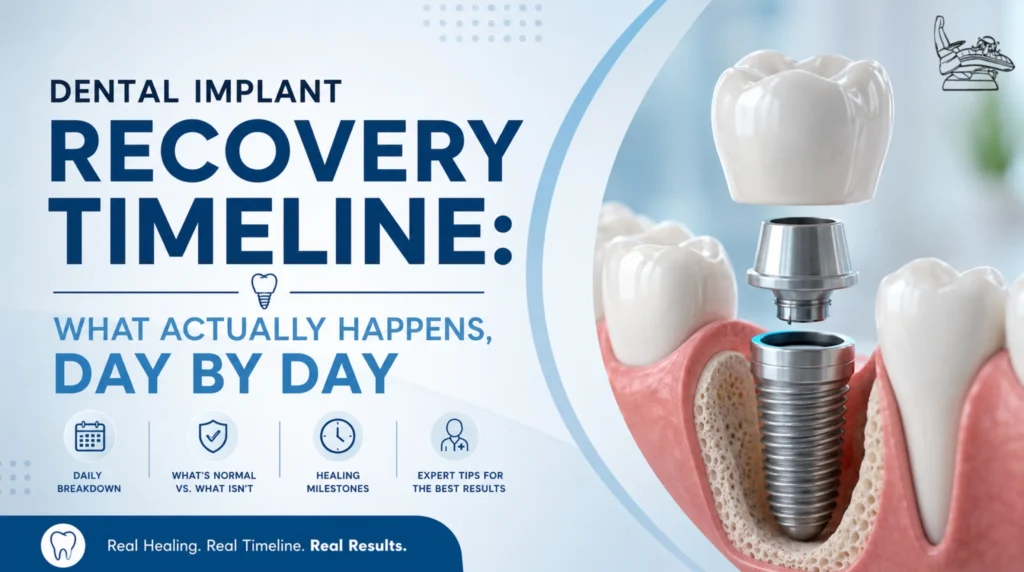
The abutment is a small connector piece that attaches to the top of the implant post and protrudes through the gum. This is what the crown sits on. Some patients receive the abutment at the same time as the implant (single-stage approach); others come back for a separate appointment.
The crown appointment involves:
- Taking impressions or digital scans of your teeth
- Selecting a shade that matches your natural teeth
- Waiting one to two weeks for the crown to be fabricated in a lab
- A final fitting appointment where the crown is attached and your bite is checked
The fitting appointment itself is usually straightforward and comfortable. Your dentist will have you bite down on paper to check your bite alignment and make any small adjustments. After that, the implant looks, feels, and functions like a natural tooth.
Some patients need a brief adjustment period — a few days to get used to the feel of the new tooth. That’s normal. What isn’t normal is the crown feeling significantly high or uncomfortable after a week, which would mean the bite needs to be adjusted.
“Is This Normal?” — A Comparison Table
The table below separates the two categories. When in doubt, err on the side of calling.
| What You’re Experiencing | Normal — Keep Monitoring | Call Your Dentist |
|---|---|---|
| Blood-tinged saliva | First 24–48 hours | Steady bleeding past 24 hours |
| Swelling in cheek/jaw | Peaks at 48–72 hours, fades by day 4–5 | Swelling increases after day 5 |
| Aching, dull pain | First 3–5 days, improving | Pain increasing after day 3–4 |
| Bruising on jaw or neck | First week | Spreading bruising with fever |
| Slightly tender implant site | Up to 2 weeks | Implant moves when touched |
| Numb feeling near the site | First 24 hours as anesthesia clears | Numbness persisting past 24–48 hours |
| Slight sensitivity to temperature | First few weeks | Sharp pain on pressure or biting |
| Tight feeling in jaw | Normal after healing abutment | Unable to open mouth comfortably |
| Foul taste or smell | Not normal at any stage | Contact your dentist promptly |
| Visible white or yellow discharge | Not normal | Call the same day |
| Fever above 101°F (38.3°C) | Not normal | Call immediately |
One rule of thumb: pain that’s improving is recovery. Pain that’s getting worse after the first few days is a signal. Don’t wait to see if it resolves on its own.
What to Eat at Each Stage of Recovery
Diet is the part of implant recovery that trips people up most. The issue isn’t just pain — it’s pressure. Even after the pain is gone, chewing on the implant side too soon can interfere with bone fusion.
Week 1: Liquid and Very Soft Foods
Your focus is protecting the blood clot and avoiding any pressure on the surgical site.
Eat freely: Yogurt, smoothies (no straw), broth, mashed potatoes without lumps, applesauce, pudding, soft-scrambled eggs, cottage cheese, protein shakes.
Avoid: Anything that requires chewing, anything hot, anything acidic (orange juice), anything sticky or crunchy.
Weeks 2–4: Soft Solid Foods
Swelling is down, soft tissue has closed. You can introduce more variety — but still on the opposite side from the implant.
Eat: Soft pasta, flaky fish, soft-cooked vegetables, scrambled or poached eggs, soft bread without crusts, ripe banana, avocado, tofu, soup with soft ingredients.
Still avoid: Hard bread, raw vegetables, nuts, seeds, steak, anything you have to tear with your teeth.
Months 1–3: Semi-Soft Diet
Most patients feel completely normal by now. No sensation from the implant, no visible reminder that anything is happening. That’s the problem. Without physical feedback, it’s easy to slip back into full eating habits before the bone is actually ready.
Stick to most regular foods, but still favor the non-implant side for chewing. The things to keep off the table: ice (people forget ice counts as a hard food), hard candy, raw carrots, whole apples, caramel, and bagels.
After Full Integration (Month 3–6 Onwards): Resume Normal Diet
Once your dentist confirms osseointegration is complete and the crown is placed, you can eat normally. The implant can handle the same forces as a natural tooth.
One exception: if you clench or grind your teeth (bruxism), talk to your dentist about a night guard. Bruxism is a common cause of late implant complications and crown damage.
Frequently Asked Questions
How much pain should I expect after dental implant surgery? Most patients describe it as less painful than a tooth extraction. The first two to three days are the most uncomfortable. Over-the-counter ibuprofen manages it well for many patients; others need a short course of prescription pain medication. By day four or five, most people are off medication entirely.
Can I go to work after getting a dental implant? Many patients take one to two days off. If your job is desk-based, you can often return on day two. Physical jobs or anything involving heavy lifting should wait at least a week.
What happens if osseointegration fails? Early failure — the implant not fusing with the bone — occurs in roughly 3–5% of cases. The implant can usually be removed, the site given two to six months to heal, and a new implant placed. It’s not a dead end, but it does extend the overall timeline significantly.
Will the implant set off airport metal detectors? No. Titanium is not ferromagnetic. It will not trigger standard airport security systems.
Can I get an MRI with a dental implant? Yes. Titanium implants are MRI-compatible. Inform the technician beforehand as a precaution, but this is not a contraindication.
How long does a dental implant actually last? Research shows a 97% success rate at 10 years and approximately 75% at 20 years. With proper oral hygiene and regular checkups, many implants last the patient’s lifetime.
Does smoking really affect implant success that much? Yes. Smoking reduces blood flow to healing tissue and impairs immune response. Multiple systematic reviews confirm significantly higher failure rates in smokers. If you smoke, your dentist needs to know — it affects the treatment plan.
When can I drink alcohol after getting an implant? Most dentists advise avoiding alcohol for at least 72 hours. Alcohol thins the blood (increasing bleeding risk) and interferes with medication. If you’re on antibiotics, avoid alcohol for the entire course.
Why does the implant process take so long? The three-to-six-month window is not dentist scheduling. It’s biology. You cannot rush osseointegration. The bone grows at the pace the bone grows. What you can do is not interfere with it.
Is there anything I can do to speed up healing? Keeping the area clean, not smoking, controlling blood sugar if diabetic, staying well-hydrated, eating a protein-rich diet, getting enough sleep, and attending your follow-up appointments. None of this dramatically shortens the timeline, but any of the opposites can extend it or cause failure.
Before You Go
Dental implants have a strong track record precisely because the process is methodical. The long timeline is what makes them durable. Patients who follow instructions and keep their follow-up appointments get predictable, lasting results.
If you have questions specific to your situation — or if you’re figuring out whether implants make sense for your case — book a consultation with Pembroke Family Dental. The team can walk you through what your personal timeline would look like based on your bone health, medical history, and whether any preliminary work like bone grafting would be needed.
You can also read more about the full implant process at Pembroke Family Dental before your first appointment.