
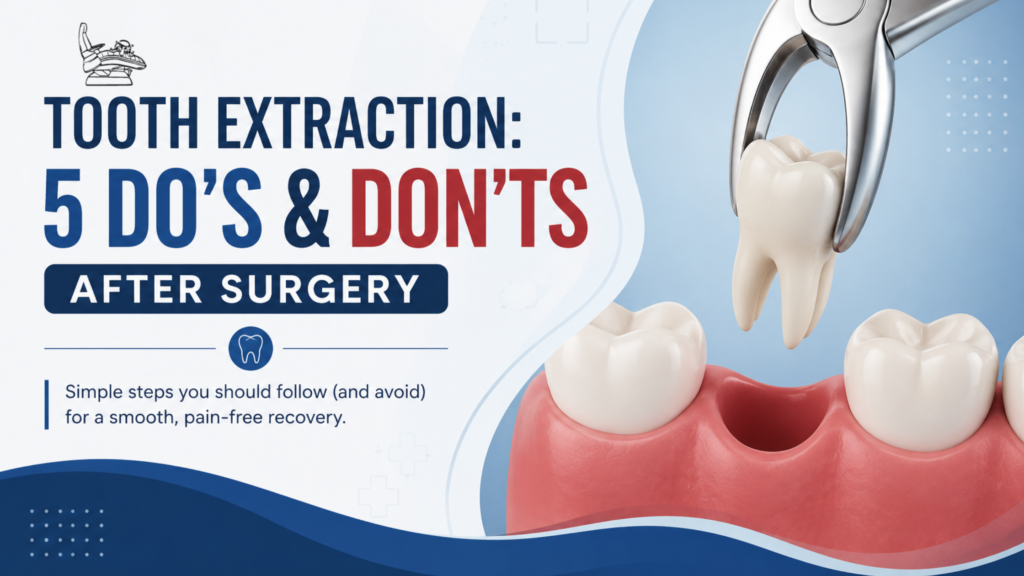
After a Tooth Extraction, most people fixate on the pain. Fair enough. But what actually derails healing — what sends people back to the dentist with dry socket, infections, or prolonged bleeding — is almost always a mistake made in the first 24 to 48 hours after the procedure.
Here’s what you need to do (and stop doing) to heal properly.
The Do’s
1. DO Use Salt Water — But Not Right Away
salt water gargling after tooth extraction is one of the most commonly searched questions after a procedure, and the answer trips people up.
Salt water rinses work. Warm salt water (half a teaspoon in a glass of water) keeps bacteria down and supports soft tissue healing. But timing matters: don’t start rinsing until 24 hours after surgery. Rinsing too early dislodges the blood clot that’s forming in the socket — the very thing your body is trying to build to protect exposed bone and nerve endings.
After that first day, rinse gently 2–3 times daily, especially after meals. No vigorous swishing. No gargling. Just let it roll around and spit slowly.
2. DO Follow Your Dentist’s Aftercare Instructions to the Letter
This sounds obvious. It isn’t. People skip doses, eat things they’re told not to, and stop taking antibiotics early because they feel fine.
At Pembroke Family Dental, post-operative care instructions are tailored to each patient — because a straightforward extraction of a front tooth heals differently than an impacted wisdom tooth removal. What your neighbor was told after their procedure may not apply to you.
If you weren’t given written instructions, ask for them before you leave the chair. If something isn’t clear, call the office. Don’t guess.
3. DO Eat Soft, Cold Foods in the First 48 Hours
Can I eat ice cream after tooth extraction? — yes, actually, and it’s one of the better choices you can make.
Cold foods reduce swelling. Soft foods don’t disturb the clot. Ice cream (plain, no crunchy mix-ins), yogurt, mashed potatoes, smoothies, and scrambled eggs are all fine. What you’re avoiding is heat, hard textures, and anything that requires serious chewing near the extraction site.
One thing most people don’t think about: eat on the opposite side of your mouth. Keep food and utensils away from the socket entirely for the first few days.
4. DO Rest and Keep Your Head Elevated
Your body heals faster when it’s not working against gravity. For the first night, sleep with your head propped up on an extra pillow. This reduces blood pooling at the surgical site, which cuts down on swelling and throbbing pain.
Rest also means actually resting — not going back to work the same afternoon if you don’t have to. Physical activity raises your heart rate and blood pressure, which increases bleeding risk. Take the day seriously.
5. DO Monitor for Warning Signs
Normal healing includes: mild bleeding (pinkish saliva) for up to 24 hours, swelling that peaks around day 2–3, and soreness that gradually decreases.
What’s not normal: sudden severe pain 3–5 days after extraction (this is classic dry socket), fever, pus, or swelling that gets worse instead of better after day 3.
If you’re a patient at Family Dental in Virginia Beach, don’t wait it out — call the office. Dry socket and post-extraction infection are both treatable, but they get worse if ignored.
The Don’ts
1. DON’T Use Mouthwash in the First 24 Hours
Can you use mouthwash after tooth extraction? Most commercial mouthwashes — including alcohol-based ones — are too harsh in the immediate post-op period.
Mouthwash after tooth extraction risks: the swishing action can dislodge your blood clot, and alcohol-based formulas can irritate the wound. What to avoid after tooth extraction includes products like Listerine, peroxide rinses, and anything with strong antibacterial chemicals in the first day. After 24 hours, if your dentist specifically cleared it, a mild, alcohol-free mouthwash may be fine — but salt water does the job better and with less risk.
2. DON’T Smoke or Use Straws
Both involve negative pressure (sucking). That pressure can pull the blood clot right out of the socket, causing dry socket — an exposed, deeply painful nerve that can sideline you for days.
Smoking doubles the problem: nicotine restricts blood flow to healing tissue, and the chemicals in cigarette smoke interfere with the immune response. If you smoke, your healing timeline is already slower than average. Lighting up in the first 72 hours makes it significantly worse.
Straws are the same mechanical risk as smoking. Use a cup, drink slowly, and keep liquids lukewarm to cool — not hot.
3. DON’T Poke, Probe, or Touch the Socket
The urge to check on it with your tongue is almost universal. Resist it. Touching the clot — with your tongue, a finger, or a toothpick — can dislodge it or introduce bacteria.
Brush your other teeth normally, but keep the toothbrush away from the extraction site for the first 24 hours. After that, brush gently around it, not on it.
4. DON’T Take Aspirin for Pain
Aspirin thins blood. After a tooth extraction, you need clotting. Taking aspirin for pain relief is actively counterproductive.
Ibuprofen (like Advil) or acetaminophen (like Tylenol) are better choices, and your dentist may have prescribed something stronger. Take whatever was recommended on schedule — not just when the pain gets bad — because staying ahead of inflammation is easier than trying to knock it back down.
5. DON’T Ignore Dry Socket
About 2–5% of extractions lead to dry socket. The risk goes up significantly after lower molar extractions, in smokers, and in patients who didn’t follow post-op care instructions.
The symptom is hard to miss: intense, throbbing pain that radiates toward your ear, usually appearing 3–5 days after extraction — right when you thought you were through the worst of it. The socket looks empty or grayish instead of dark red.
It’s not an emergency, but it does need treatment. Your dentist will clean the socket and place a medicated dressing that provides near-immediate relief. Don’t try to manage it at home.
A Note on Timing
Most people are surprised by how front-loaded the restrictions are. The critical window is the first 24–72 hours. After that, most of the high-risk activities become lower-risk as the clot matures into healing tissue.
By day 7, most patients are largely back to normal. Full socket healing takes about 3–4 weeks, and complete bone fill can take 3–6 months — but you won’t feel that process happening.
If you have questions about recovery after a procedure, the team at Pembroke Family Dental and Family Dental in Virginia Beach can walk you through what to expect for your specific case. Recovery isn’t one-size-fits-all, and getting clear answers upfront saves a lot of unnecessary pain later.