
June 2, 2026

Tooth Extraction
Blog

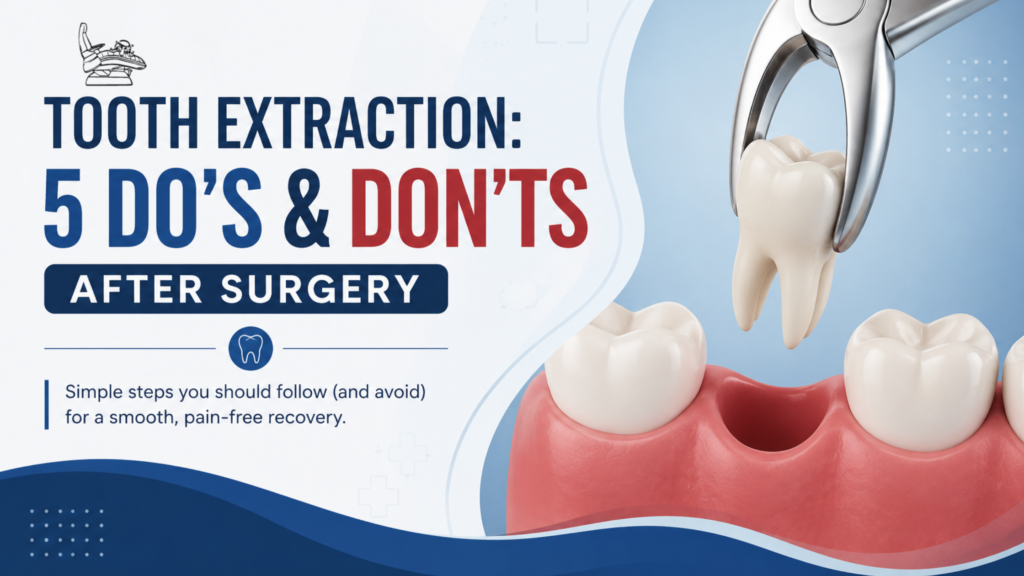
Tooth Extraction: 5 Do’s and Don’ts After Surgery

After a Tooth Extraction, most people fixate on the pain. Fair enough. But what actually derails healing — what sends people back to the dentist with dry socket, infections, or prolonged bleeding — is almost always a mistake made in the first 24 to 48 hours after the procedure. Here’s what you need to do (and stop doing) to heal properly. The Do’s 1. DO Use Salt Water — But Not Right Away salt water gargling after tooth extraction is one of the most commonly searched questions after a procedure, and the answer trips people up. Salt water rinses work. Warm salt water (half a teaspoon in a glass of water) keeps bacteria down and supports soft tissue healing. But timing matters: don’t start rinsing until 24 hours after surgery. Rinsing too early dislodges the blood clot that’s forming in the socket — the very thing your body is trying to build to protect exposed bone and nerve endings. After that first day, rinse gently 2–3 times daily, especially after meals. No vigorous swishing. No gargling. Just let it roll around and spit slowly. 2. DO Follow Your Dentist’s Aftercare Instructions to the Letter This sounds obvious. It isn’t. People skip doses, eat things they’re told not to, and stop taking antibiotics early because they feel fine. At Pembroke Family Dental, post-operative care instructions are tailored to each patient — because a straightforward extraction of a front tooth heals differently than an impacted wisdom tooth removal. What your neighbor was told after their procedure may not apply to you. If you weren’t given written instructions, ask for them before you leave the chair. If something isn’t clear, call the office. Don’t guess. 3. DO Eat Soft, Cold Foods in the First 48 Hours Can I eat ice cream after tooth extraction? — yes, actually, and it’s one of the better choices you can make. Cold foods reduce swelling. Soft foods don’t disturb the clot. Ice cream (plain, no crunchy mix-ins), yogurt, mashed potatoes, smoothies, and scrambled eggs are all fine. What you’re avoiding is heat, hard textures, and anything that requires serious chewing near the extraction site. One thing most people don’t think about: eat on the opposite side of your mouth. Keep food and utensils away from the socket entirely for the first few days. 4. DO Rest and Keep Your Head Elevated Your body heals faster when it’s not working against gravity. For the first night, sleep with your head propped up on an extra pillow. This reduces blood pooling at the surgical site, which cuts down on swelling and throbbing pain. Rest also means actually resting — not going back to work the same afternoon if you don’t have to. Physical activity raises your heart rate and blood pressure, which increases bleeding risk. Take the day seriously. 5. DO Monitor for Warning Signs Normal healing includes: mild bleeding (pinkish saliva) for up to 24 hours, swelling that peaks around day 2–3, and soreness that gradually decreases. What’s not normal: sudden severe pain 3–5 days after extraction (this is classic dry socket), fever, pus, or swelling that gets worse instead of better after day 3. If you’re a patient at Family Dental in Virginia Beach, don’t wait it out — call the office. Dry socket and post-extraction infection are both treatable, but they get worse if ignored. The Don’ts 1. DON’T Use Mouthwash in the First 24 Hours Can you use mouthwash after tooth extraction? Most commercial mouthwashes — including alcohol-based ones — are too harsh in the immediate post-op period. Mouthwash after tooth extraction risks: the swishing action can dislodge your blood clot, and alcohol-based formulas can irritate the wound. What to avoid after tooth extraction includes products like Listerine, peroxide rinses, and anything with strong antibacterial chemicals in the first day. After 24 hours, if your dentist specifically cleared it, a mild, alcohol-free mouthwash may be fine — but salt water does the job better and with less risk. 2. DON’T Smoke or Use Straws Both involve negative pressure (sucking). That pressure can pull the blood clot right out of the socket, causing dry socket — an exposed, deeply painful nerve that can sideline you for days. Smoking doubles the problem: nicotine restricts blood flow to healing tissue, and the chemicals in cigarette smoke interfere with the immune response. If you smoke, your healing timeline is already slower than average. Lighting up in the first 72 hours makes it significantly worse. Straws are the same mechanical risk as smoking. Use a cup, drink slowly, and keep liquids lukewarm to cool — not hot. 3. DON’T Poke, Probe, or Touch the Socket The urge to check on it with your tongue is almost universal. Resist it. Touching the clot — with your tongue, a finger, or a toothpick — can dislodge it or introduce bacteria. Brush your other teeth normally, but keep the toothbrush away from the extraction site for the first 24 hours. After that, brush gently around it, not on it. 4. DON’T Take Aspirin for Pain Aspirin thins blood. After a tooth extraction, you need clotting. Taking aspirin for pain relief is actively counterproductive. Ibuprofen (like Advil) or acetaminophen (like Tylenol) are better choices, and your dentist may have prescribed something stronger. Take whatever was recommended on schedule — not just when the pain gets bad — because staying ahead of inflammation is easier than trying to knock it back down. 5. DON’T Ignore Dry Socket About 2–5% of extractions lead to dry socket. The risk goes up significantly after lower molar extractions, in smokers, and in patients who didn’t follow post-op care instructions. The symptom is hard to miss: intense, throbbing pain that radiates toward your ear, usually appearing 3–5 days after extraction — right when you thought you were through the worst of it. The socket looks empty or grayish instead of dark red. It’s not an emergency, but it does need treatment. Your dentist will clean the socket and place
preventive dental care
Blog

The Importance of Preventive Dental Care: Building Healthy Habits for Life

Introduction Most people visit the dentist reactively. Something hurts, or a friend says something looks off, and suddenly an appointment gets booked. In between those moments? Nothing. This isn’t unique behavior. Dental problems are quiet. A cavity forming in a back molar won’t announce itself for months — sometimes years. By the time you feel it, you’re no longer looking at a cleaning. You’re looking at a filling, possibly a root canal, and the kind of bill that makes you wish you’d gone six months earlier. Preventive dental care exists for exactly this reason. Not to scare you into the chair, but to keep small problems from turning into expensive ones. What Is Preventive Dental Care? What is preventive dental care, stripped of jargon? It’s every action — at home and at the dentist — taken to stop oral health problems before they develop. That includes brushing and flossing daily, eating in a way that doesn’t feed bacteria, getting professional cleanings on schedule, and letting your dentist catch issues while they’re still manageable. What is preventive dentistry as a field? It’s the branch of dentistry that focuses on maintaining oral health rather than repairing it. Restorative work — fillings, crowns, implants — becomes necessary when prevention breaks down. But restorations are always a fallback. They’re never the goal. The goal is a mouth that doesn’t need that work. What Are Dental Preventive Services? When people ask what are dental preventive services, they expect a short answer. It’s actually a broader category than most realize. Professional services: Routine cleanings (prophylaxis) — Removes hardened plaque (tartar) that brushing can’t reach. Most patients need this every 6 months; those with gum disease history may need it more often. Oral exams — Your dentist checks for cavities, gum disease, bite problems, signs of wear, and early indicators of oral cancer. Dental X-rays — Catches decay between teeth, bone loss, and impacted teeth before they’re visible or symptomatic. Fluoride treatments — Strengthens enamel. Useful for children, and for adults with higher cavity risk than average. Dental sealants — A thin coating applied to the chewing surfaces of back teeth. Shown to dramatically reduce cavity rates in children and teenagers. Periodontal screenings — Gum disease is the leading cause of adult tooth loss. Catching it early changes the treatment outcome significantly. Oral cancer screenings — A quick check your dentist can do during any routine visit. Early detection matters a lot here. At-home practices: Brushing twice daily with fluoride toothpaste Flossing once daily Replacing your toothbrush every 3–4 months Limiting sugary and acidic foods and drinks Using mouthwash when your dentist recommends it These two sides — professional and at-home — make up a full preventive treatment dental program. They depend on each other. Skipping either one leaves real gaps. The Real Cost of Skipping Routine Dental Visits The routine dental visits importance isn’t just about your health. It’s about your wallet. Here’s what the math looks like: A small cavity caught at a routine visit: roughly $150–$300 to fill That same cavity, left undetected until it reaches the pulp: a root canal ($700–$1,500) plus a crown ($1,000–$1,800) Untreated gum disease progressing to bone loss: periodontal surgery or implants, which run into thousands Most dental insurance covers preventive visits at 100%. Restorative work typically comes in at 50–80% coverage. The gap between those two numbers is exactly what neglect costs. There’s also the health piece, which gets underplayed. Chronic gum disease is linked to higher risk of cardiovascular disease, diabetes complications, preterm birth, and respiratory infections. Bacteria living in infected gum tissue don’t stay contained in your mouth. They enter the bloodstream. Two cleanings a year isn’t just about keeping your teeth — it’s managing systemic inflammation that starts in your gums. Preventive Dental Care Tips You Can Start Today Most of preventive dental care happens at home, not at the dentist. Brush correctly, not just often. Two minutes, twice a day, with a soft-bristled brush. Angle the bristles toward the gumline at 45 degrees. Most people brush the flat surfaces and miss the gumline almost entirely — which is exactly where decay and gum problems start. Floss. Actually floss. Brushing covers about 60% of tooth surfaces. Flossing covers what’s left. Skipping it means leaving roughly half your mouth unclean every night. Watch what you drink. Soda, sports drinks, and fruit juice are acidic. They soften enamel every time they contact your teeth. If you drink them regularly, use a straw and rinse with water afterward. It’s not a perfect fix, but it helps. Take dry mouth seriously. Saliva neutralizes acids and washes bacteria off teeth. Medications, mouth breathing, and simple dehydration all reduce saliva flow. If your mouth is frequently dry, mention it to your dentist — it raises cavity risk considerably. Replace your toothbrush before it looks worn. Frayed bristles don’t clean well. Most people wait too long. Set a calendar reminder every three months and don’t overthink it. Keep your dental appointments even when nothing hurts. This sounds obvious. It isn’t — because the whole point of preventive care is that nothing hurts yet. Skipping a cleaning because you feel fine is backwards thinking. What Preventive Dentistry Looks Like for Families Children’s teeth are not just smaller adult teeth. They have thinner enamel, they decay faster, and the habits formed around them tend to stick for life. For kids, preventive dentistry means: First dental visit by age 1, or within 6 months of the first tooth erupting Sealants applied to permanent molars as soon as they come in Fluoride varnish every 6 months Learning correct brushing technique early — with a parent supervising until around age 8 For adults, the focus shifts. Gum disease risk climbs. Recession becomes something to watch. Teeth grinding — often stress-driven — quietly wears enamel down for years before anyone notices. A night guard is a cheap solution to an expensive problem. Most people never get one because they don’t know they grind their teeth. There’s a

Scroll to Top