
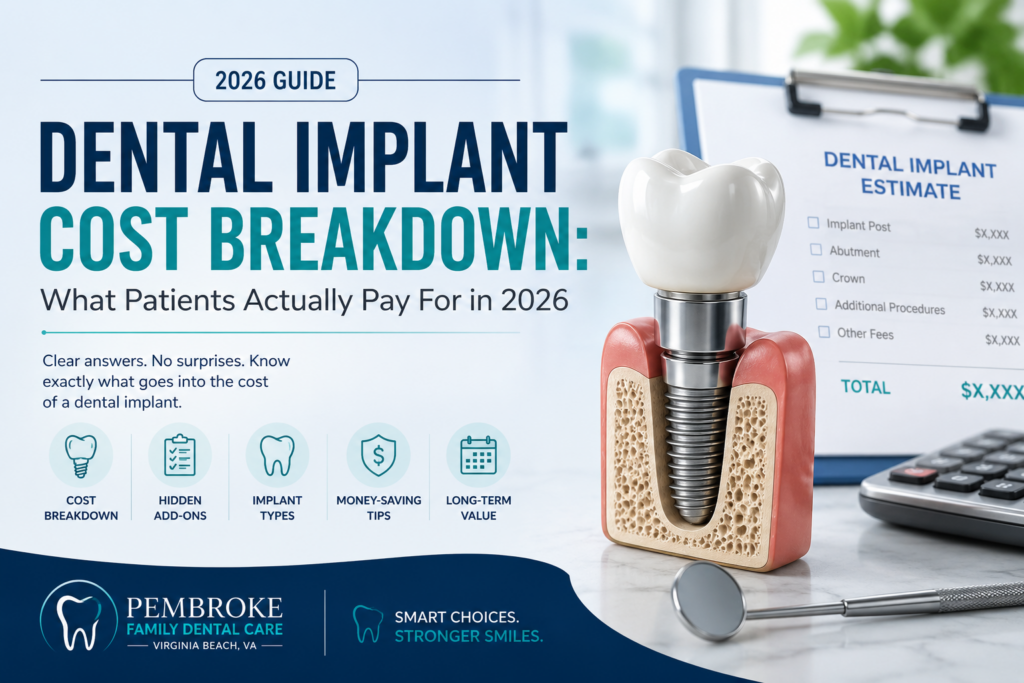
Dental Implant Cost Breakdown: What Patients Actually Pay For in 2026
Most people searching for dental implants price get a number — somewhere between $1,500 and $6,000 — with no explanation of what that number includes. Then they sit down with a treatment coordinator and discover the real total is twice that. This article breaks down exactly where that money goes, what you can skip, what you can’t, and what patients at Pembroke Family Dental Care in Virginia Beach actually encounter during the process. What a Dental Implant Actually Costs in 2026 A single-tooth implant, fully completed with post, abutment, and crown, typically runs between $3,000 and $5,500 in the United States in 2026. That’s the all-in number when no preparatory work is needed. If you need a bone graft, extraction, or CT scan, add another $500 to $5,000 depending on complexity. Full-mouth dental implant surgery — meaning implants across both jaws — ranges from $30,000 to $90,000. That’s not a typo. The variation comes from how many implants are placed, which prosthetic solution you choose, and how much bone work your jaw requires beforehand. Here’s the number most ads won’t show you: the average American patient who goes through a complete single-implant dental implant procedure pays roughly $4,200 to $4,800 out of pocket, after factoring in limited insurance coverage. The Three Core Components You’re Paying For Every dental implant procedure has three distinct parts. Each is billed separately. Each comes with its own price range. 1. The Implant Post This is the titanium screw that gets placed into your jawbone. It acts as an artificial root. Most posts run between $1,000 and $3,000 depending on brand, material (titanium vs. zirconia), and whether a specialist or general dentist performs the placement. The post itself is permanent — barring implant failure, you should never need to replace it. 2. The Abutment The abutment is the connector piece between the post and the visible tooth. Stock abutments are cheaper ($300–$500). Custom-milled abutments designed for your specific bite angle cost more ($700–$1,200). If your implant is in a visible spot — a front tooth, for example — your dentist will likely recommend a custom abutment for a better cosmetic fit. 3. The Crown The crown is the tooth you actually see. Porcelain-fused-to-metal crowns sit at the lower end of the price range ($800–$1,200). Full zirconia crowns — more durable and more aesthetic — run $1,500–$3,000. Crowns are not permanent in the same way the post is. Most last 10–15 years before they need replacement. The post stays; the crown eventually goes. The Hidden Add-Ons That Inflate Your Final Bill This is where patients get surprised. The quoted dental implants cost at a consultation often covers only the three core components above. What it frequently excludes: Consultation fee: $75–$300 Panoramic X-ray: $100–$200 Cone-beam CT scan (CBCT): $250–$600 — required in most cases to assess bone density and map nerve locations before surgery Tooth extraction: $150–$500 for a simple pull; $400–$800 for a surgical extraction Bone graft: $500–$3,000. Necessary if you’ve had bone loss from a long-missing tooth, infection, or periodontal disease. Bone grafts also add 3–6 months of healing time before the implant can be placed. Sinus lift: $1,500–$5,000. Required when upper back molars need implants but the sinus cavity sits too low. This is a surgical procedure with its own recovery period. Temporary restoration: $300–$800. Some patients need a temporary crown or flipper tooth while osseointegration (the process of bone fusing to the implant) takes place over 3–6 months. Sedation: $300–$1,000 depending on whether you choose local anesthesia, nitrous oxide, oral sedation, or IV sedation. A patient who needs an extraction, bone graft, CT scan, and sedation on top of the standard implant components can easily hit $7,000–$9,000 for a single tooth. Not common, but not rare either. Types of Dental Implants and How Each Affects Price Understanding the types of dental implants helps you ask better questions when comparing quotes. Endosteal implants are the standard: titanium screws placed directly into the jawbone. The vast majority of patients get these. Price range as discussed above. Subperiosteal implants sit on top of the jawbone beneath the gum, held by a metal framework. These are rare now — used when bone volume is severely inadequate and grafting isn’t viable. They tend to cost more due to the custom fabrication involved. Mini dental implants are narrower than standard implants. They’re placed in a less invasive procedure, often in a single visit, and cost roughly $500–$1,500 per implant. They’re useful for stabilizing lower dentures or in patients with limited bone. They’re not a direct substitute for standard implants in every situation — don’t let low price alone drive the decision. All-on-4 / All-on-6 implants use 4 or 6 implants per arch to anchor a full-arch prosthesis. Per-arch cost runs $15,000–$30,000. Per implant this looks inexpensive, but the prosthetic fabrication and surgical complexity are substantial. These are permanent, fixed teeth — not removable dentures. Zirconia implants are metal-free alternatives for patients with titanium sensitivities or aesthetic preferences. They cost 20–40% more than titanium equivalents and have a somewhat shorter clinical track record, though outcomes have been improving consistently. Dental Implants vs. Dentures: The Real Cost Comparison Dental implants vs. dentures is the most common comparison patients make, and it’s usually framed the wrong way. Traditional full dentures cost $1,000–$3,500 for a complete set. That’s the upfront number. What the comparison often ignores: Dentures need relining every 1–3 years as the jaw shrinks (yes, your jaw shrinks without tooth roots stimulating bone — that’s not scare tactic language, it’s biology). Relines cost $300–$600 each. Dentures typically need full replacement every 5–8 years: another $1,000–$3,500 each time. Adhesives, cleaning solutions, and repair costs add up over decades. Bone loss from missing teeth accelerates without implants, which can eventually affect facial structure and make future implant placement harder or impossible. Over 20 years, a patient who starts with full dentures often spends $8,000–$15,000 in cumulative maintenance and replacement — without ever getting the stability or bone preservation that implants provide. That